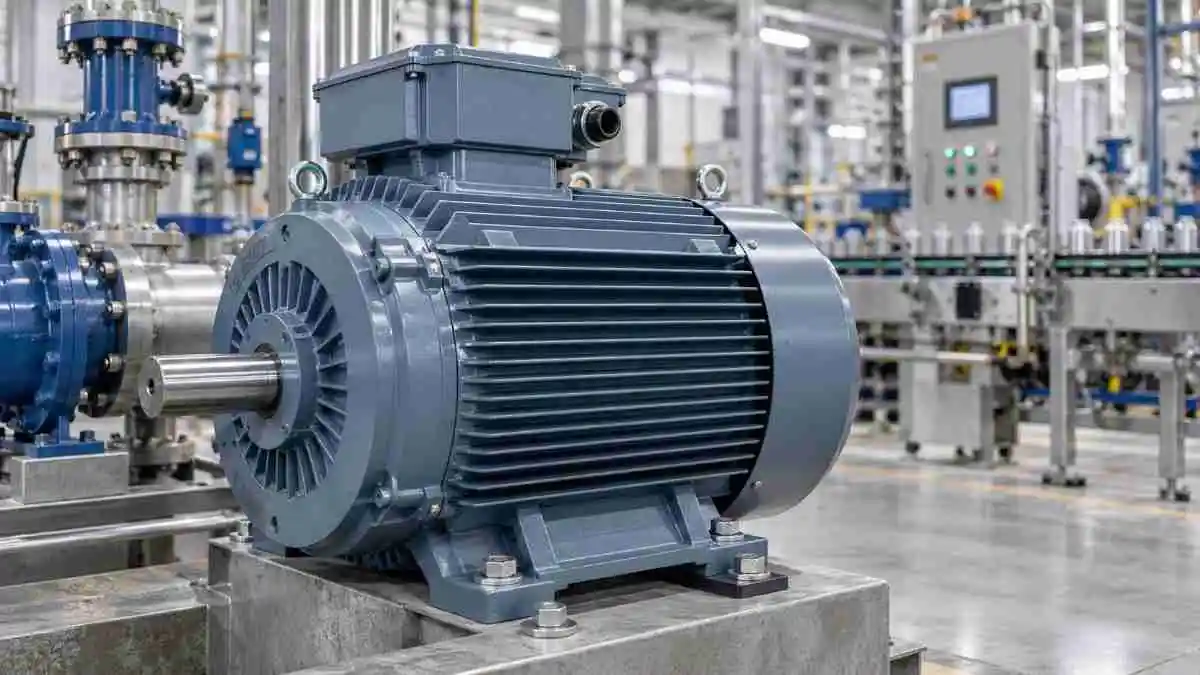
Machinery that runs all day doesn't forgive a bad motor choice. Get it wrong and output slips, maintenance bills climb, and safety becomes a real question on the floor. That's part of why Siemens Motors keep coming up in industrial procurement talks — they hold up under continuous load, plain and simple. For businesses sourcing through authorised dealers, reliability isn't some nice-to-have; it's the starting point. So why do Industrial Siemens Motors get specified so often across manufacturing and process industries? That's what this blog digs into.
What Are Siemens Motors?
So what exactly is a Siemens Electric Motor? At its simplest — an industrial-grade drive unit that turns electrical energy into mechanical rotation, the workhorse behind countless machines. Siemens Motors come in a wide spread of frame sizes, power ratings and enclosure types, and configurations shift a lot depending on what they're driving. Some suit constant-speed work, others pair with variable-frequency drives. Bottom line: there's no single "right" motor, just the one that fits the job at hand.
Why Industries Prefer Siemens Motors
Brand name alone doesn't win over industrial buyers — never has. What they're really after is solid build quality, performance data they can trust, and support that sticks around after the invoice clears. So here's a look at why Siemens Motors for Industrial Applications keep landing on approved-vendor lists.
Energy Efficiency and Optimized Performance
Efficiency doesn't just sit on a spec sheet — it shows up on the electricity bill.
Run several motors at once, and an Energy Efficient Motor starts to matter: less wasted heat, steadier output over long duty cycles. Numbers vary by model and load. But size a motor right for the job, and Siemens Motor Efficiency tends to follow, along with costs that stop creeping up.
A few things that actually move the needle:
- Correct motor sizing for the actual load — not oversized "just in case"
- Insulation class and thermal design suited to ambient conditions
- Load factor and duty cycle matching the application
- Routine maintenance to prevent efficiency drift over time
Reliable Performance for Industrial Operations
Downtime on one machine rarely stays contained to just that machine.
Reliability matters most on equipment that can't afford to stop — conveyors, pumps, compressors, the continuously running stuff. A dependable Siemens Industrial Motor cuts down on surprise failures once it's matched right to load and environment. For plants sourcing through Altra Power, that means fewer emergency swaps and maintenance planning that actually holds up.
What reliability really comes down to:
- Matching motor rating to the actual mechanical load
- Proper alignment and mounting during installation
- Scheduled bearing and lubrication maintenance
- Protection against voltage fluctuations and overloads
|
Did You Know? “A motor running even slightly oversized for its load doesn't just waste energy — it can also operate at a lower, less efficient point on its own performance curve.”
|
Durability for Demanding Working Conditions
Not every shop floor looks the same, and motors need to handle that.
Industrial settings range from dry, climate-controlled rooms to dusty, humid, high-vibration ones. Siemens Motors come in different enclosure ratings, but here's the catch — the enclosure must match actual site conditions, since a motor built for one setting won't survive another. Get the right Industrial Electric Motor build for the environment, and service life stretches out.
Worth checking before you decide:
- Ambient temperature and ventilation around the installation point
- Dust, moisture or chemical exposure
- Vibration levels from adjacent or connected machinery
- Duty cycle intensity — continuous vs. intermittent
Wide Range of Industrial Applications
One motor rarely fits every job — the application decides the spec, not the other way round.
Siemens Motor Applications span pumps, fans, conveyors, compressors and machine tools, each pulling different torque, speed and starting demands. Figure out what the driven equipment actually needs, instead of reaching for a familiar spec, and Industrial Siemens Motors keep performing the way they're supposed to.
A few categories that show up again and again:
- Centrifugal and positive-displacement pumps
- Industrial fans and blowers
- Belt and roller conveyors
- Air and gas compressors
- CNC and general machine tools
Common Industrial Applications of Siemens Motors
Across sectors, the pattern holds — motors sit at the center of equipment that can't be allowed to stop.
From production lines to warehouses moving material, motors sit at the working core of most industrial setups on the ground. Siemens Motor Applications stretch into HVAC systems, process equipment, packaging lines and automation, where consistent rotation keeps everything downstream running smoothly, day in and day out. Buyers sourcing through Altra Power tend to span sectors like metal fabrication, food processing, pharma and logistics — each carrying its own load profile, but the same task underneath: a motor that hits its rated spec, day after day, without surprises or unexplained downtime.
Sectors and use-cases that come up often:
- Manufacturing and production machinery
- Material handling and conveyor systems
- Pumping stations and water treatment
- HVAC and building systems
- Packaging and automation lines
|
Trivia: “The first practical AC induction motor was patented in 1888 — the same core principle still powers most industrial motors used today, including many Siemens motor designs.”
|
Key Factors When Selecting a Siemens Motor
Choosing the right motor is a technical call, not a brand one. Siemens Motor Selection needs to weigh power, speed, environment and mounting together — not one factor at a time, evaluated in isolation from everything else that determines how the equipment actually performs on-site.
Power, Speed and Torque Requirements
These three numbers usually decide whether a motor works, or burns out fast.
Siemens Motor Power (HP/kW) has to match the mechanical load, while Siemens Motor RPM sets whether equipment runs at the right speed, directly or geared. Siemens Motor Torque depends on load type — high-inertia loads need a different curve than steady ones.
Worth confirming before you lock in a spec:
- Required horsepower/kW for the actual load
- Rated RPM and any gearing or belt-drive ratios
- Starting torque needed for the connected equipment
- Load type: constant, variable or high-inertia
Duty Cycle and Operating Environment
How long and how hard a motor runs changes what it needs to survive.
Siemens Motor Duty Cycle ratings decide whether it's built for continuous work or shorter, intermittent runs — pick the wrong one, and life shortens fast. Ambient conditions count just as much: dust, moisture and temperature swings call for different protection on an Industrial Siemens Motor.
A quick checklist for the site:
- Continuous (S1) vs. intermittent duty classification
- Ambient temperature range at the installation site
- Dust and moisture exposure — IP rating needs
- Altitude, if applicable to the site
Mounting and Application Compatibility
Even a technically sound motor can fail to fit — literally.
Siemens Motor Selection has to account for frame size, shaft dimensions, mounting style (foot or flange) and coupling method with the driven equipment. A Siemens Electric Motor that ticks every electrical box but doesn't line up physically still means delays and extra cost.
Double-check these before ordering:
- Frame size and shaft diameter compatibility
- Foot-mount vs. flange-mount requirements
- Coupling or belt-drive alignment
- Available installation space and orientation
Continuous Duty vs. Intermittent Duty — At a Glance
| Parameter |
Continuous Duty (S1) |
Intermittent Duty |
| Typical Application |
Pumps, conveyors, compressors |
Machine tools with pause cycles |
| Duty Definition |
Runs continuously at rated load |
Runs, then rests, in a repeating cycle |
| Thermal Design Need |
Sustained heat dissipation |
Tolerates shorter heat build-up |
| Common Fit |
Siemens Motor rated for S1 duty |
Siemens Motor rated for S2/S3 duty |
Fact: “Bearing failure is one of the most common causes of unplanned motor downtime — which is why lubrication schedules matter just as much as the motor specification itself.”
What Industrial Buyers Should Check Before Purchasing
The motor itself is only half the decision — who you buy it from is the other half.
Verifying model numbers, datasheets and certification documents up front prevents mismatches down the line. Working with a credible Siemens Motor Supplier matters just as much as the spec, since availability and after-sales support shape total cost of ownership. Buyers looking at Siemens Motors in India should confirm their Siemens Motor Dealer actually backs it up — support, warranty, parts, all of it.
Before you sign off on a purchase, check:
- Exact model/spec against the technical datasheet
- Certification and compliance documentation
- Supplier's after-sales and technical support record
- Stock availability and expected lead times
- Warranty terms and replacement-part access
Conclusion
| Siemens Motors gets picked for industrial work when reliability, efficiency and application fit outweigh brand familiarity alone. Getting it right means weighing power, duty cycle, environment and mounting together, not grabbing a motor off a catalog page. For businesses evaluating Siemens Motors, Altra Power offers guidance through that process, plus access to genuine motor options. |