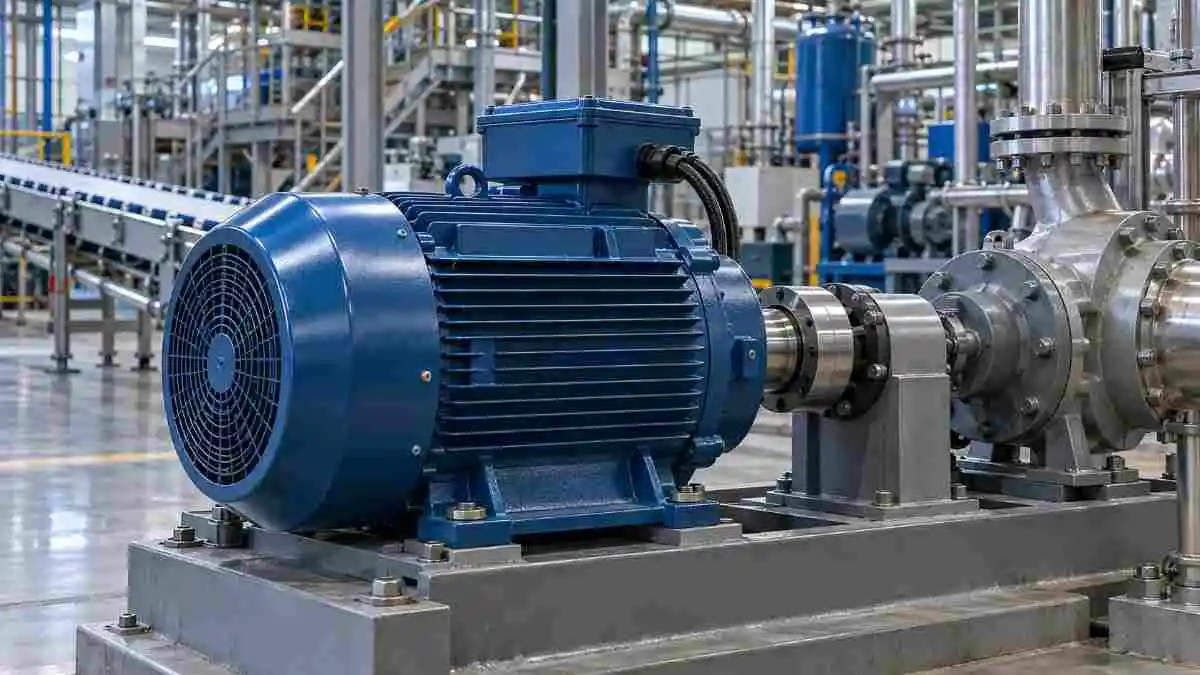
Step onto any factory floor and listen. That steady hum is usually an induction motor at work. It turns electricity into rotation without brushes or sliding contacts, so there's very little inside to wear out. We at Altra Power see the same pattern everywhere: the Industrial Induction Motor quietly runs pumps, conveyors, compressors and fans. From induction motor applications in food plants to steel mills, the core idea barely shifts. We'll start there and build up.
How Does an Induction Motor Generate Mechanical Motion?
The concept of the induction motor is based on one basic fact, that is, a moving magnetic field is capable of forcing a current into a nearby conductor. This is how an AC Induction Motor functions.
- Current flows through the stator winding.
- This produces a magnetic field which revolves around the stator.
- This revolving magnetic field forces a current into the rotor bars.
- Current in the rotor creates a second magnetic field.
- The two fields interact, and that push is torque.
- Torque turns the shaft. Simple as that.
- Nothing feeds the rotor directly. That's the neat part.
- On a three-phase motor, swapping any two supply leads reverses direction.
Role of the Stator and Rotor
Two parts, two clear jobs. Dead simple, and that's the appeal.
- The induction motor stator sits still and builds the rotating field.
- The induction motor rotor follows it, picking up current by induction.
- No direct electrical connection to the rotor means less to wear out.
- A squirrel-cage rotor is basically bars and end rings. Not much to maintain.
How Slip Helps an Induction Motor Produce Torque
Here's something that surprises people: the rotor never fully catches the field.
- Synchronous speed is simply how fast the field rotates.
- Induction motor slip is the shortfall between that and the rotor's real speed.
- Zero slip would mean zero induced current, and therefore no induction motor torque.
- Add load and slip grows, which lifts torque.
Did You Know? “Back in 1888, Nikola Tesla received patents for the induction motor. His design has outlasted nearly every gadget of that era, and it still turns pumps in plants across India.”
What Happens When an Induction Motor Is Connected to Industrial Machinery?
Theory is tidy, but a plant floor isn't. Once the shaft is coupled to a machine, the motor just reacts to whatever that machine asks for, and that is the whole point of an induction motor for industrial machinery. Here's what to expect:
- Power reaches the machine through a coupling, belt or gearbox.
- Heavy load? The motor draws more current and slip climbs.
- Light load? The shaft spins nearer to synchronous speed.
- Rate any industrial electric motor for peak demand, not only the average.
How Induction Motors Work in Pumps and Fluid Handling Systems
Pumps are among the hardest-working motor jobs. An induction motor for pumps drives the impeller that moves water, coolant and process liquids, sometimes for days on end. For a solid industrial pump motor setup, think about:
- Long hours at a fairly constant load.
- The pump curve, not a rough guess, when sizing.
- Head and flow the AC induction motor will really see.
- A bit of spare capacity, since start-up is tougher than running.
How Induction Motors Power Conveyor Systems
Conveyor belts in packing halls and warehouses don't need drama. They need smooth, repeatable movement, shift after shift. Frequent stops and starts are tough on any drive, which is exactly where an induction motor for conveyors proves itself. A good conveyor motor offers:
- Enough starting torque to get a loaded belt moving.
- Steady torque through continuous duty.
- Easy pairing with a gearbox for slower belt speeds.
- Fewer surprise stoppages on the line.
How Induction Motors Operate Compressors, Fans and Blowers
Air is unforgiving about speed. Pressure and flow follow rotation, so an induction motor for compressors or a blower motor must hold steady. A small drift in speed throws pressure off, and the rest of the line pays for it. You'll spot these motors in:
- Compressors for plant air and refrigeration.
- Large industrial fans and blowers.
- HVAC and ventilation plants in large buildings.
- Cooling towers and process-air lines.
- Dusty sites, where enclosure choice matters as much as power.
Did You Know? “Here's a handy rule: fan power goes up with the cube of speed. Run a fan 20% slower and it draws roughly half the power.”
Single Phase vs Three Phase Induction Motors in Industrial Use
This isn't a generic comparison. It's about where each type really earns its place. A Single-Phase Induction Motor suits lighter loads and sites that only have single-phase supply. Three-phase induction motors take on the heavier, tougher work. Here's how we'd split them:
- Single phase suits small fans, bench tools and light pumps.
- Three phase: compressors, conveyors, big pumps, whole production lines.
- Three phase starts more smoothly and runs more efficiently at higher power.
- Single phase motors tend to stop at modest power ratings.
- Let load size and your actual supply make the call.
How Speed, Torque and Load Affect Induction Motor Operation
Selection of an unsuitable motor will lead to feedback through heat and/or noise. Induction Motor Speed and Torque should be compatible with the load. Before selection, note that:
- Induction Motor Speed is dependent on the supply frequency and number of poles.
- More poles always means a lower speed.
- Take 50 Hz supply: two poles give about 3000 RPM, four poles about 1500.
- Starting torque has to beat the machine's breakaway torque.
- Big swings in Industrial Motor Load need some headroom.
- Undersized motors overheat and trip out.
- Oversized ones waste energy at light load.
How VFDs Improve Induction Motor Control in Industrial Systems
A Variable Frequency Drive lets you tune the motor to the process, not the other way round. An Induction Motor with VFD becomes far more flexible. In practice, you get:
- Soft, controlled acceleration, with less shock on couplings.
- Real Variable Speed Motor operation as demand shifts.
- Lower energy use at partial load.
- Tighter Industrial Motor Control, with protection built in.
- Better results from an AC Induction Motor on fans and pumps.
Why Three Phase Induction Motors Are Common in Continuous Operations
Plants that run day and night hate surprises. That's why Three Phase Induction Motors fill most Industrial Induction Motor lineups built for Continuous Duty Motor work. On the floor, they stand out for:
- Torque smooth and vibration is very low.
- Can handle medium to heavy loads easily.
- Performs uniformly using pumps, compressors, and conveyors.
- Fewer wearing parts than most motor types, so servicing stays easy.
- A natural fit for production equipment that almost never stops.
What Factors Affect Induction Motor Performance in Real Applications?
This is just half the story. Site factors determine the life span of the motor and have a bigger impact on induction motor performance than many think. A hot, dusty plant with poor alignment can shorten motor life even when sizing is perfect. Watch these:
- Proper Induction Motor Load matching.
- Stable voltage and balanced phases.
- Good ventilation and a sensible running temperature.
- Shielding against dust and moisture.
- Strong base and shaft alignment.
- Greasing, cleaning and maintenance on a regular basis.
- This all goes towards Industrial Motor Efficiency.
How to Match an Induction Motor With an Industrial Application
Most motor trouble starts at the buying stage, and a little homework prevents it. Run through this list before picking from the Altra Power Induction Motor range, and your Induction Motor Selection will go much smoother. Here's the checklist:
- Power in HP or kW.
- Single or three phase supply.
- RPM and torque needed at the driven machine.
- Duty cycle starts per hour.
- Enclosure type, such as TEFC, and mounting arrangement.
- Operating environment: heat, dust, moisture or corrosion.
- VFD compatibility, if speed control is planned.
Conclusion
Strip it back and an induction motor is simple: electromagnetic induction in, steady rotation out. That's why the industrial induction motor keeps winning on pumps, conveyors and compressors. Get the size, phase and control right and it'll serve you for years.
| Explore the AC induction Motor range from Altra Power speak to our team before you buy. |