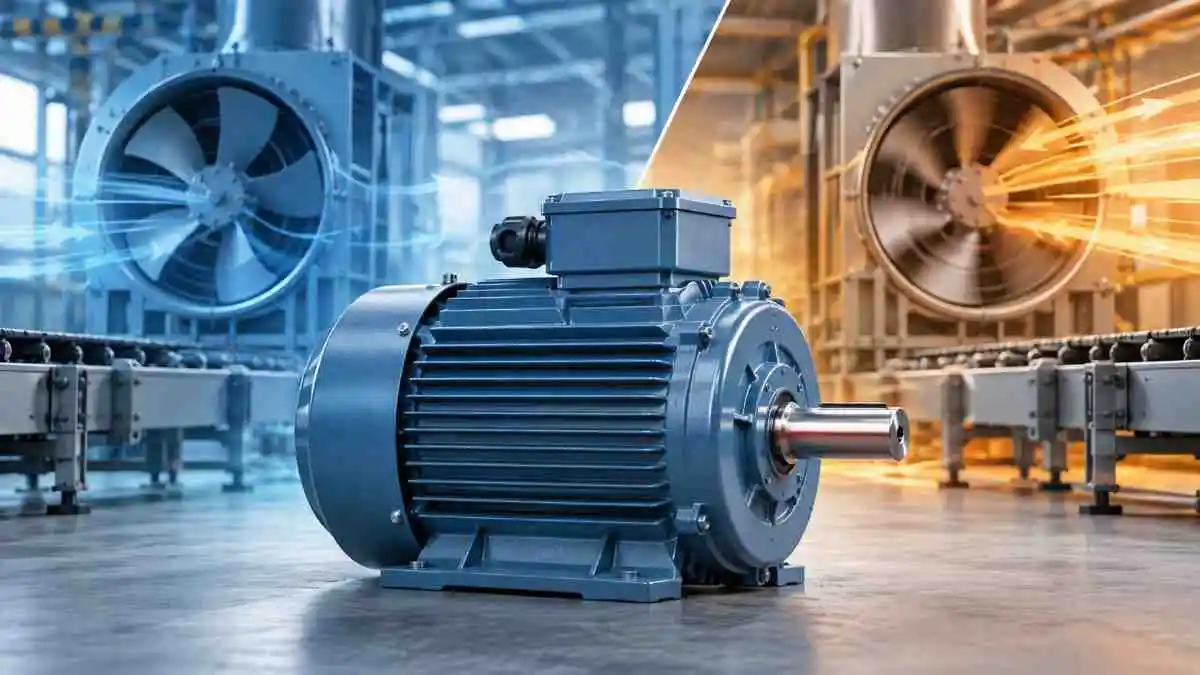
Ever notice how a factory rarely runs at just one pace? That's the gap a Dual Speed Motor fills. Built to run at two set speeds instead of one, it lets operators match output to whatever the job actually needs — something a plain single-speed unit just can't manage. Fans, conveyors, HVAC lines, you name it — a Dual Speed Electric Motor brings efficiency and control together in one frame.
What Is a Dual Speed Motor?
So what exactly is a Dual Speed Motor? Simply put, it's an induction motor built to run at two fixed speeds — not one constant RPM like a standard motor. A regular single-speed unit gives you the same output no matter what's happening on the floor.
A Two Speed Motor doesn't work that way; it shifts between a lower and higher setting as the job demands. That's what makes a Dual Speed Electric Motor genuinely useful for machinery handling uneven loads.
Here's the short version of what makes it different:
- Two fixed speeds, not one
- Speed shift usually comes down to winding or pole design
- Handles changing demand without a motor swap
- One motor instead of two — less hardware, less hassle
How Does a Dual Speed Motor Work?
The Dual Speed Motor Working Principle really comes down to poles — literally. Motor speed is tied to how many magnetic poles it has and the supply frequency, so change the pole count and you change the speed. A lot of two-speed designs use pole-changing windings, which let one motor frame run at two pole arrangements off a single power feed.
Other designs just use separate windings for each speed instead. Either way, the manufacturer's spec sheet decides the method — the result's the same: two reliable speeds, one compact motor.
Speed Switching and Control
How do you actually switch speeds? Usually through a control panel, contactors, or dedicated switchgear — depends on the setup. This lets machinery jump from a slow start-up speed to full running speed without swapping the motor out. Worth noting: the control arrangement isn't one-size-fits-all — it changes with motor design, load type, and what the application calls for.
|
Trivia: “Pole-changing motors aren't new — they've been around for over a century, built originally so one motor could do the job of two.”
|
Key Benefits of Using a Dual Speed Motor
Why go dual speed at all? A few solid reasons, really. Dual Speed Motor Benefits show up most clearly for B2B buyers running demanding, multi-load setups where one fixed speed just won't cut it.
Better Process and Speed Control
Two speeds mean operators can match motor output to whatever stage the process is in — slower for start-up, faster once things are running. That kind of Motor Speed Control takes pressure off connected equipment and keeps output steady, even when demands shift mid-cycle.
Improved Energy Utilization
Not every job needs full output. Running at a lower speed when it doesn't can — depending on the setup — trim unnecessary energy use. That's exactly why an Energy Efficient Dual Speed Motor appeals to plants trying to cut power costs without giving up performance when it actually matters.
Greater Operational Flexibility
One Dual Speed Electric Motor covering two speed needs means fewer motors to stock, wire, and maintain. That's real flexibility — machinery can adjust output on the fly instead of being locked into a single pace, which matters once production demand keeps shifting.
|
Did You Know? “Some plants swap two single-speed motors for one dual-speed unit — same coverage, less wiring, fewer spares to keep around.”
|
Common Applications of Dual Speed Motors
Where do Dual Speed Motor Applications actually show up? Pretty much anywhere equipment needs to run at different speeds depending on load or airflow.
A few places you'll spot them:
- Fans and blowers needing variable airflow
- Pumps dealing with flow that won't stay constant
- Conveyors with throughput that changes shift to shift
- Machine tools running different cutting speeds
- Textile machinery moving through multiple stages
- HVAC systems balancing comfort against efficiency
Dual Speed Motor vs Single Speed Motor
Dual Speed Motor vs Single Speed Motor — which one actually fits? A single-speed motor's simpler, and it's fine if your load never changes. A Two Speed Motor makes more sense once operations start varying. Yes, control gets a bit more involved, but you gain far more coverage from one unit. Load variability is really what decides it.
Quick comparison, side by side
| Feature |
Single Speed Motor |
Dual Speed Motor |
| Operating Speeds |
One fixed speed |
Two predefined speeds |
| Application Flexibility |
Best for constant loads |
Best for variable loads |
| Control Complexity |
Simple |
Moderately higher |
| Equipment Need |
May require multiple motors |
One motor covers two speed needs |
| Suitable For |
Constant-speed processes |
Processes with changing speed demands |
Factors to Consider When Selecting a Dual Speed Motor
Before buying, a handful of technical details deserve a real look — treat this like an actual Dual Speed Motor Buying Guide, not a checkbox exercise.
Power, Speed and Torque Requirements
What HP or kW do you actually need? What are both target speeds in Dual Speed Motor RPM terms? And what torque does each speed require? Get the Dual Speed Motor Power rating and Motor Torque wrong, and the motor won't match your equipment's load — full stop.
Duty Cycle and Operating Conditions
How often does the motor start, stop, or switch speeds? That's the Dual Speed Motor Duty Cycle, and it matters more than people think. Add in temperature, dust, moisture, and daily run hours — all of it shapes how long any Industrial Motor actually lasts on the job.
Mounting and Application Compatibility
Don't skip the physical stuff — mounting type, frame size, shaft specs, machinery fit. A perfectly good Dual Speed Motor Selection on paper can still cause installation headaches if nobody checked whether it actually fits the equipment.
|
Fact: “More poles, lower base speed — that's just how induction motors work. It's an inverse relationship, plain and simple.”
|
Choosing a Reliable Dual Speed Motor Manufacturer
Not every Dual Speed Motor Supplier operates at the same level. Some cut corners on testing; others don't. Worth checking a few things before signing off.
Before you commit to a manufacturer:
- Real manufacturing capability, not just a catalog
- In-house quality testing, not outsourced guesswork
- Customization options for specific specs
- Documentation you can actually verify
- Support that responds when something goes wrong
Looking for a Dual Speed Motor in India? Working with someone like Altra Power — technical depth plus service that actually responds — makes the whole process a lot less painful.
Conclusion
A Dual Speed Motor really does bring efficiency, flexibility, and dependable performance into one unit. Once you understand how it works and where it beats a single-speed setup, the decision gets a lot easier. Need adaptable speed control for your machinery? Altra Power 's range is worth a look — built to match the job, not just fill a spec sheet.