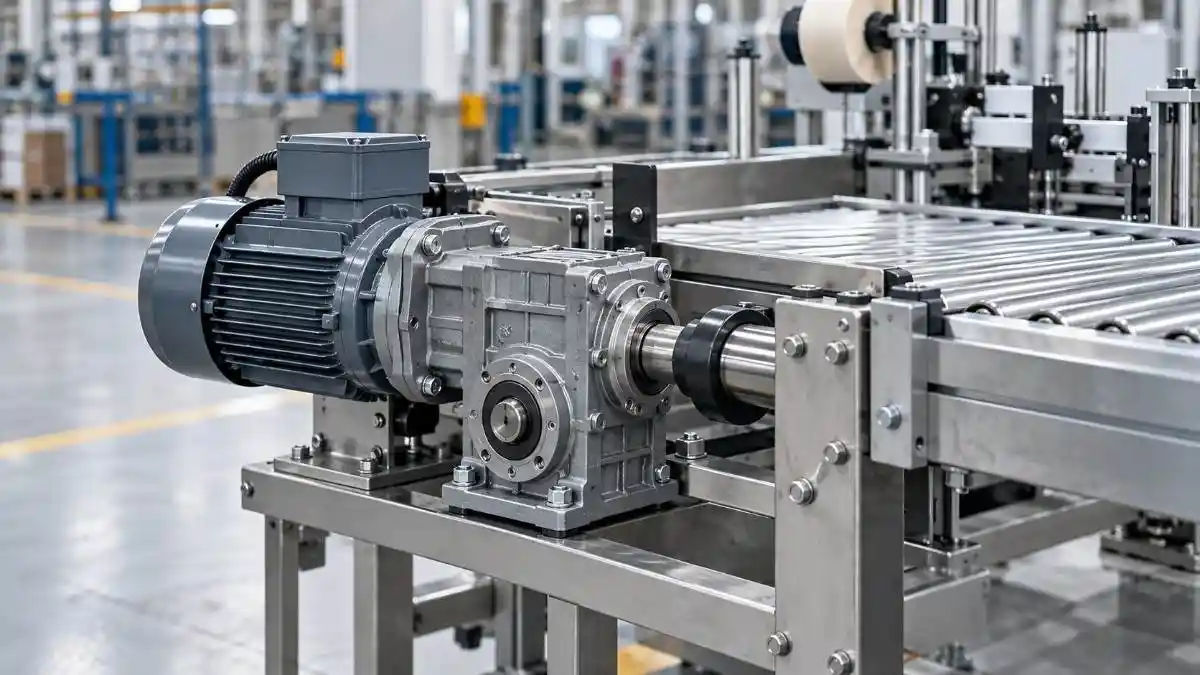
Slow but continuous motion is common on most factory floors. Just imagine a short conveyor, labeling head or textile rollers. There is an Industrial Worm Gear Motor responsible for their functioning, reducing speed and increasing torque in a compact package that can be mounted directly inside a machinery. However, there is one more thing that should be taken into account. The incorrect choice of power, torque and speed can result in malfunctions, overheating or premature wear of the machine. This Altra Power Guide will help you choose the right one.
What Is an FHP Worm Gear Motor?
A fractional horsepower worm gear motor is a small electric motor paired with a worm gearbox. The “fractional” part just means that the rating is less than 1 HP. Inside, the shaft of a worm engages with the wheel, causing a reduction in speed and an increase in torque. The power is transmitted at a right angle as well.
So what do you actually get from this design? Quite a lot:
- Strong torque at low speed.
- Compact, right-angle body.
- Quiet, smooth running, because the contact is sliding, not hammering.
- Self-locking in many ratios. Handy, but never a substitute for a brake where safety is at stake.
Trivia: “Worm-type drives are among the oldest gear ideas. Some historians trace the screw principle back to Archimedes, more than 2,000 years ago.”
Key Factors to Consider When Choosing an FHP Worm Gear Motor
There are five steps that help you determine if a motor suits your machinery. Overlook any step and you might pay for it in the future. Go through each step sequentially, and FHP gear motor selection becomes much simpler regardless of the type of industrial gear motor you want.
1. Look into the Power and Load Requirements
Start with looking at the load – how much weight must the motor move, and how many times the load starts and stops? A fractional horsepower motor able to cope with a light roller might have problems starting to work with a loaded belt. Here starting torque plays an important role because starting a load requires more torque than maintaining it.
Altra Power offers these motors with the following power options to meet different requirements:
- 25W, 40W, 60W and 90W for light-duty applications.
- 0.25 HP, 0.5 HP and 1 HP for standard industrial use.
- Jerky or heavy load? Size up. Don’t overwork any motor.
2. Evaluate Output Speed, Torque and Gear Ratio
Output RPM tells you how fast the machine moves. Torque tells you how much push it has. The gear ratio links the two. A higher worm gear reduction ratio gives slower output and more torque, and a lower ratio does the opposite. Why does this matter? A conveyor running too fast jams packs. Too slow, and your output drops.
Keep these points in mind while choosing:
- Fix the target output RPM first. Work backwards to the ratio.
- Motor speeds run from 720 to 2880 RPM.
- Ratios run from 5:1 to 100:1.
- Need a high torque low RPM gear motor? Look at the higher ratios.
- Check torque at the output shaft, not just the motor’s power rating.
3. Select Single Phase or Three Phase Motor
Your power supply decides this one, so check what your site actually has before anything else. Voltage options include 110V, 220–240V and 415V.
The practical difference looks like this:
- Single Phase FHP Worm Gear Motor: Suits small machines, commercial setups and places with limited supply.
- Three Phase FHP Worm Gear Motor: Built for plants that run long hours, day after day. Smoother and steadier.
Don’t force a single-phase unit into a heavy daily job. It will run hot and wear faster.
4. Consider Mounting Type and Installation Space
Space and shaft layout can rule out a motor before torque even comes up. Measure the gap first, then check how the output shaft meets your machine.
Common mounting styles include:
- Foot mounted gear motor (B3): Bolts to a base. Simple, stable.
- Flange mounted gear motor (B5): Fixes straight onto the machine face.
- Face mounted (B14): Smaller flange for tighter spots.
- Foot and flange combined.
A compact worm gear motor with an output shaft at a right angle saves space. Just make sure the shaft is of proper size.
5. Check Duty Cycle, Efficiency and Maintenance
How long will the motor run each day? That’s your duty cycle. The Altra Power range is built for continuous S1 duty, but heat still builds up if the load is too high or ventilation is poor.
Do these before making your decision:
- Efficiency: Worm gears are not efficient since there are some losses due to friction between them and helical gears; hence, the efficiency of the worm gear motor will be low.
- Oil Lubrication: Frequency and amount.
- Service factor: Add a margin for shocks and frequent starts.
- Wear: a rising whine or extra heat? Inspect it early.
- Overload: Avoid it. It’s the quickest way to shorten gearbox life.
Common Industrial Applications of FHP Worm Gear Motors
Where do they find their relevance? In all places where gradual and precise movements are required. Their output is slow and stable, hence making the process smooth and safe.
Common FHP worm gear motor applications are as follows:
- Packaging and labeling: A reliable gear motor for packaging machines ensures the proper timing of packages.
- Conveyor systems: Reliable conveyor gear motor which helps in moving the part without any jerk.
- Textile machines: Spinning and processing machines.
- Automation processes: Robots, gates, doors.
- Material handling: Lifting and positioning.
How to Evaluate FHP Worm Gear Motor Manufacturers in India
A good motor starts with a good maker, so don’t judge by catalogue photos alone. Ask for proof. Compare FHP Worm Gear Motor Manufacturers on facts, not claims. Altra Power has been manufactured since 1993 and backs its range with quality control and performance testing.
While selecting your suppliers, you should ask from each one the following:
- Technical data sheets for power, RPM, ratio, mountings, and duty cycle.
- Torque ratings at the output shaft.
- Build quality: Housing material such as die-cast aluminium or cast iron.
- Customisation: Special speeds, shafts or mounting.
- Testing before dispatch.
- After-sales support: Who picks up the phone when something fails?
Conclusion
The selection of a proper FHP worm gear motor involves five aspects - load and power, speed and ratio, supply, mounting, and duty cycle. Get these right and the motor runs smoothly for years. Altra Power Electrical Industries, a trusted name among FHP Worm Gear Motor Manufacturers In India, offers 25W to 1 HP options in single and three phase. Share your requirements, and our team will help you pick the right one.
Need the right FHP worm gear motor for your machine?
| Tell your load, speed and mounting needs to Altra Power, and get expert guidance on the right motor. |